

Preparing to Hit the Road
- Jerry Fuller
- Jul 18, 2020
- 4 min read

We are hoping to be able to begin planning some of the RV trips that we put on hold due to COVID-19. For the next few months we are likely to stay within Texas. A couple of years ago we rented a trailer and visited Big Bend State Park, so perhaps that would be a good destination. Beyond that visiting Durango, Colorado and the National Parks in southern Utah are high on our priority list. We also want to return to Yellowstone at some point.

Our new RV is very nice, and it is a comfortable way to travel and camp for Alana and I along with Ellie. Ellie is getting used to travelling and seems to enjoy being on the road with us. We have a lot of nice features including a generator that runs off the coach’s gasoline tank if we are staying somewhere without electric power. The opposing slides in the living area provide a lot of room to move around and the slide in the bedroom allows good access to the queen-sized bed (which is very comfortable). In addition to propane heat, the AC unit is a heat pump which provides both air conditioning and heat.
We are working on some upgrades to make things more convenient as we begin to take trips of longer duration.
Cooking

The RV has a 3-burner gas range along with a microwave oven and convection oven. It can get a bit warm when cooking inside in the warmer months so being able to grill outdoors is an important alternative. Over the years I have had bad luck with portable gas grills. I recently purchased a Blackstone 22” griddle which is very nice. I have more cooking options beyond what I can prepare on a grill grate. In addition to the 1-pound propane bottles, I have a quick-connect line that attaches directly to the RV and uses our onboard propane tanks. Very handy. The cast iron griddle plate is a bit heavy, but the carrying case provides good protection and it fits well in the RV storage compartment.
Internet
Wi-Fi at RV parks is generally poor and deteriorates the further your site is from the office. We both have cellular hot-spots available on our phones, but both have data caps. We both use a lot of data for keeping up with our websites, as well as streaming videos and TV.
I have been looking at other options. YouTube has been very helpful, and I have found that a log of RVers have posted videos on how they have solved the problem. The Mobile Internet Resource Center has been very helpful. They explain a wide range of options for RV and marine applications. One option which is interest, though expensive, is imbedded cellular modems. These are high-end products from Peplink and Cradlepoint. Both offer the ability to operate with multiple SIM cards and support AT&T, Verizon, T-Mobile/Sprint. While they have cellular antennas that attach to the device it is also possible to connect an antenna mount to the roof of the RV. The units can also be hard-wired to the RV’s DC power so that the internet is available while driving.
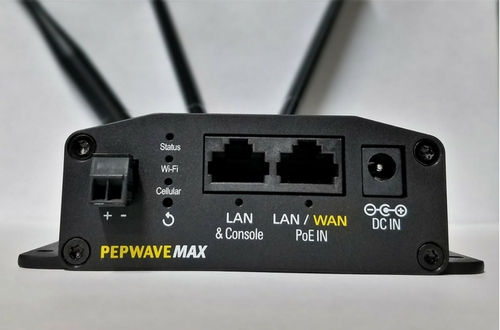
While the entry cost of the equipment is pretty high, it could replace the Wi-Fi for the house as well. Since we are in a rural situation, we have struggled to get good reception. Our current plan with VGI Technology cost $100 per month and we get 20 Mbps download speed and no data caps. It is a radio-wave technology and we can see the tower from our front porch. While it has been pretty reliable, we still get some streaming interruptions when we are both online.
The Peplink solution has a range of 250-300 feet. We park our RV at the house about 150 feet away. We have 30-amp power to the RV when parked so it is likely that it would be fully functional for the house as well. Actually, the unit is small enough that it could be unplugged and plugged back in at the house.
A Peplink reseller, MobileMustHave, provides solution bundles that include the modem and roof antenna. In addition, they have a few options for data plans with unlimited data. AT&T is $120 per month and AT&T + Verizon at $189 per month.
This is a commercial grade product that is focused more for law enforcement, buses and trucks. While it is a bit over the top, I could spend a lot of money on a solution that is a lot less robust. Anyway, I am having fun checking out options and watching videos.
TV

Most RV parks have Cable TV available which is generally free even though we have been to one park that charged an additional $5.00. I cut the cable with DirecTV about a year ago and went with YouTube TV. Unfortunately, they have just raised their rate to $65 per month, but they have the channels that we like including Sky Sports coverage of F1 racing. I connect to my TVs with Apple TV which needs both power and Wi-Fi. It connects to the TVs with an HDMI cable. The RV has 3 TVs and there is one in the living room in the house. Each has an HDMI cable and I move the Apple TV (it is 4”x4”x1.5” and weighs 15 ounces), remote and power cable to the TV I want to use. The quality is excellent.
Summary
Things are beginning to fall into place, and we are anxious for the opportunity to hit the road, but with an eye on staying safe. I will post later with an update on the Wi-Fi solution that we settle on. Looking forward to sharing our adventures and photos.


Comments